

 English
 中文简体
中文简体
CEY crepe material is a 100% polyester woven fabric recognized in the apparel trade for its fine, pebbled surface and soft, fluid drape. Unlike standard flat polyester fabrics, CEY crepe undergoes a special twisting and finishing treatment that gives it a dry, textured hand feel. For garment factories and fashion brands sourcing blouses, dresses, and lined jackets, understanding what CEY crepe actually is—its construction, its performance limits, and how to verify quality at the mill—makes the difference between a smooth production run and costly rejects.
What Is CEY Crepe Fabric?
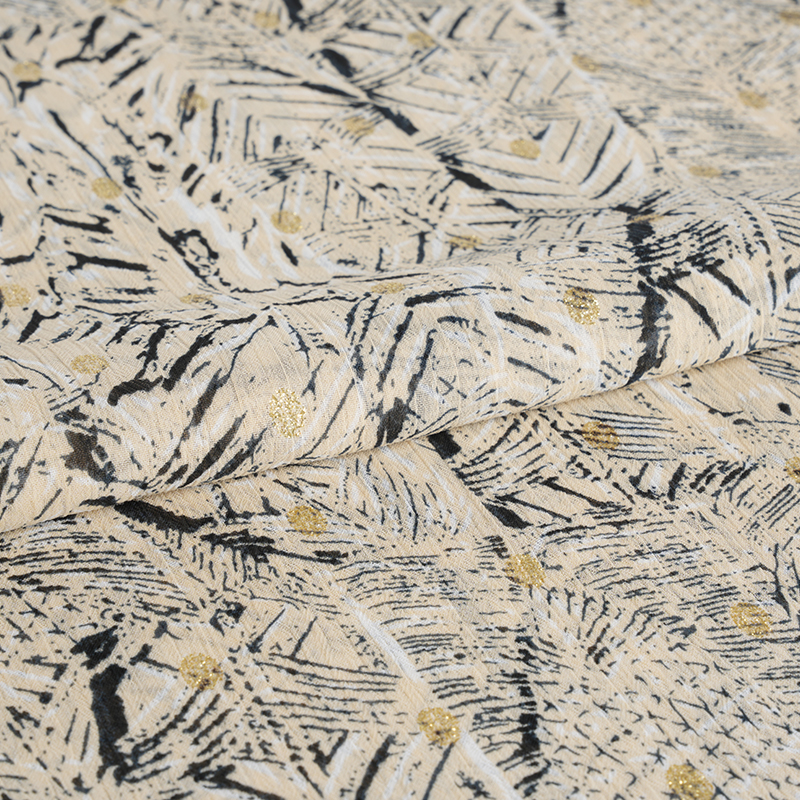
CEY is an abbreviation used across Chinese textile mills for a specific polyester crepe construction. The yarn is highly twisted in both warp and weft directions. When the fabric is dyed and finished, the high-twist yarns contract unevenly, creating the characteristic crepe texture—a fine, grainy surface that does not lie flat. This is why CEY crepe is frequently described as having a "dry touch" or "sandy" surface, distinct from the slippery smoothness of satin or the crispness of plain taffeta. It is a lightweight, opaque material, usually woven from fully drawn polyester yarns (FDY) rather than textured yarns, which contributes to its crispness and resilience.
In the woven fabric category, CEY crepe is most often produced in plain weave but also appears as a 2/1 twill variant. Both versions share a common DNA: high-twist polyester yarn, pronounced surface texture, and a slightly elastic feel in the drape.
Key Specifications and Construction Details
When reviewing technical datasheets from suppliers, focus on yarn count, weight, and weave structure. These parameters determine drape, opacity, and sewing behavior. The table below summarizes industry-standard specifications for CEY crepe fabric commonly used in women's apparel.
| Parameter | Typical Range | Impact on Finished Garment |
|---|---|---|
| Material | 100% polyester (FDY) | Dimensional stability, wrinkle resistance |
| Yarn count | 75D to 180D | Lower denier gives lighter weight, finer texture |
| Weave structure | Plain, 2/1 twill | Plain for softness; twill adds body and structure |
| Weight / width | 80–120 g/m²; 145–150 cm | Affects garment falling and lining requirements |
| Finish | Plain dyed, printed, or yarn-dyed | Color depth, surface hand, care behavior |
For product-specific reference, these practical examples help calibrate buying expectations. The plain CEY fabric at 75D falls in the lightweight side of the range—suitable for relaxed silhouettes. A more structured option is the 180D CEY 2/1 twill, which gives jackets and structured dresses more body while keeping the dry crepe aesthetics.
Manufacturing Process: How the Crepe Texture Is Achieved
The characteristic feel of CEY crepe comes from a combination of yarn preparation and finishing. Understanding the main steps helps buyers recognize why quality varies so much between suppliers.
Yarn Selection and Twisting
Polyester filaments are twisted at high twist multiples to create the contraction force inside the yarn. This is performed on a two-for-one twister. The twist direction alternates or is set in a specific pattern so that when the yarn relaxes, the fabric surface becomes uneven instead of curling.
Weaving
High-twist yarns are notoriously difficult to weave. They tend to kink and create warp breaks. Mills must use sizing agents and carefully controlled loom tensions. The quality of the weaving step appears directly on the finished surface: a well-woven CEY crepe has a uniform texture, while a poorly woven one shows uneven spots and defects that cannot be corrected at dyeing.
Dyeing and Shrinkage Control
The greige fabric is first relaxed and pre-shrunk in a water bath, which allows the crepe effect to develop. Dyeing is typically carried out at high temperature in a jet dyeing machine. After dyeing, the fabric is heat-set to stabilize the texture and control shrinkage.
Finishing
Depending on end use, the fabric may receive additional treatments such as a softener for a smoother hand, a hydrophilic finish for moisture management, or a wrinkle-resistant finish. Calendering is avoided in most cases because it would flatten the crepe surface. This process chain explains why CEY crepe is more expensive than an equivalent weight of flat polyester fabric—not because of the fiber cost, but because of the processing steps involved.
Performance Characteristics and Their Effect on Garments
CEY crepe's performance profile explains why it remains a preferred material for many women's garment categories. The table below summarizes the main features and their practical consequences.
| Attribute | Observed Behavior | Practical Benefit |
|---|---|---|
| Drape | Fluid, falls away from the body | Flattering in A-line dresses and wide-leg trousers |
| Opacity | Generally opaque at 100 g/m² and above | Reduces the need for additional lining in dresses |
| Wrinkle resistance | Recovers well from creasing | Good for travel wear and workwear blouses |
| Abrasion resistance | Good due to filament yarns | Sustains repeated washing and wear |
| Moisture absorption | Low (inherent to polyester) | May require wicking finish for summer styles |
| Elasticity | Limited but present (2–5%) | Provides slight give in fitted styles |
One tradeoff deserves explicit attention. Because CEY crepe is 100% polyester, garments retain heat. For summer dresses and shirts intended for tropical markets, specify a moisture-wicking or cooling finish during development. Alternatively, choose a blended variant if the design requires natural-fiber breathability.
Primary Applications in Women's Apparel
CEY crepe material covers an unusually broad range of garment types. This versatility is a direct consequence of its surface texture and weight.
| Garment Category | Recommended Weight | Why It Works |
|---|---|---|
| Blouses and shirts | 75D–100D | Lightweight, does not cling, fits structured or soft silhouettes |
| Dresses | 75D–120D | Fluid fall, opaque enough to skip linings in many designs |
| Skirts and wide-leg trousers | 120D–180D | Heavier weight gives a cleaner line and better movement |
| Jackets and kimono coats | 180D twill | Crisper drape, holds shape without heavy interfacing |
| Headscarves and hijabs | 75D | Opaque, breathable, holds folds without slipping |
The plain-dyed version remains the most widely ordered because it allows garment factories to print or embroider in-house. However, the use of CEY crepe for presentations, hijab collections, and loungewear is growing quickly, particularly in markets that value the texture-to-price ratio.
How to Assess CEY Crepe Quality Before Bulk Ordering
Quality issues in CEY crepe do not always appear on a small swatch. A production run can be jeopardized by problems that only show after cutting and sewing. Experienced buyers check the following points.
Visual and Tactile Checks
- Hold the fabric against the light: the crepe texture should be uniform, with no flat patches or streaks.
- Rub the surface: a high-quality CEY crepe has a consistent granular feel across the full width; any slippery or smooth areas indicate uneven finishing.
- Fold a sample and release it: it should spring back without a sharp crease line remaining.
Sewing and Cutting Behavior
- Pin two layers together and check for excessive slipping—polyester filament fabrics can shift during cutting, especially in slippery finishes.
- Request a sewing test to verify seam pucker, which happens when the needle damages the filaments.
- Check for fusing or melting around cut edges when using hot cutting tools.
Color and Shrinkage Verification
- Verify that the shade depth meets your target. CEY crepe absorbs dye well, but a deep black or navy requires a quality dyehouse.
- Ask for shrinkage test results after wash, in both warp and weft directions. Acceptance below 3% is a common industry threshold.
- Verify colorfastness to water and rubbing, especially for darker shades.
For more background on how different lining and fabric choices affect durability and comfort—an area that directly relates to how CEY crepe performs in layered garments—refer to the guide on lining material selection.
Customization Options and Development Considerations
CEY crepe lends itself to various customization routes. A supplier that understands crepe handling can develop a fabric that distinguishes your collection without unnecessary engineering cost.
Color and Printing
The most common customization is color development. Pantone matching on CEY crepe should account for the fact that the textured surface absorbs light differently from smooth fabrics—the same dye formula will appear slightly darker and less glossy on CEY than on satin. Digital printing on CEY crepe works well for smaller quantities and multicolor patterns.
Weave and Weight Adjustments
Depending on the target garment, yarn count can be adjusted or the weave changed. A 2/1 twill CEY crepe is a well-established option when the design requires more structure. Changing the weave requires re-testing drape, shrinkage, and sewing behavior, so budget for these development steps.
Functional Finishes for Specific End Uses
- For tropical climates or active wear: moisture-wicking finish.
- For dresses and tops that touch the skin directly: a softener for a smoother hand or a skin-friendly neutral pH confirmation.
- For scarves and hijabs: anti-slip edge finishes or an extra-soft rinse to improve foldability.
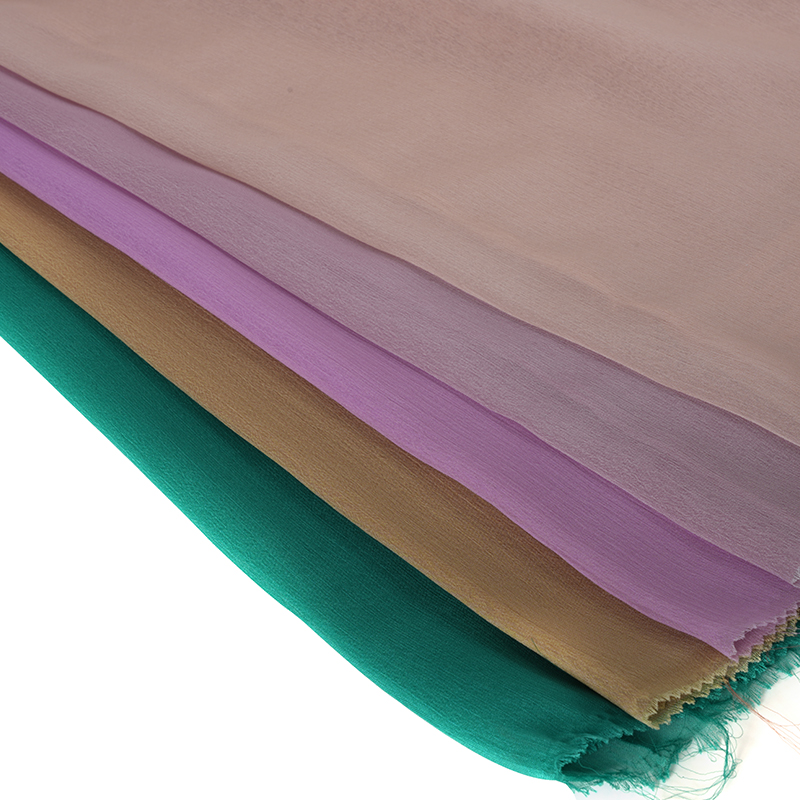
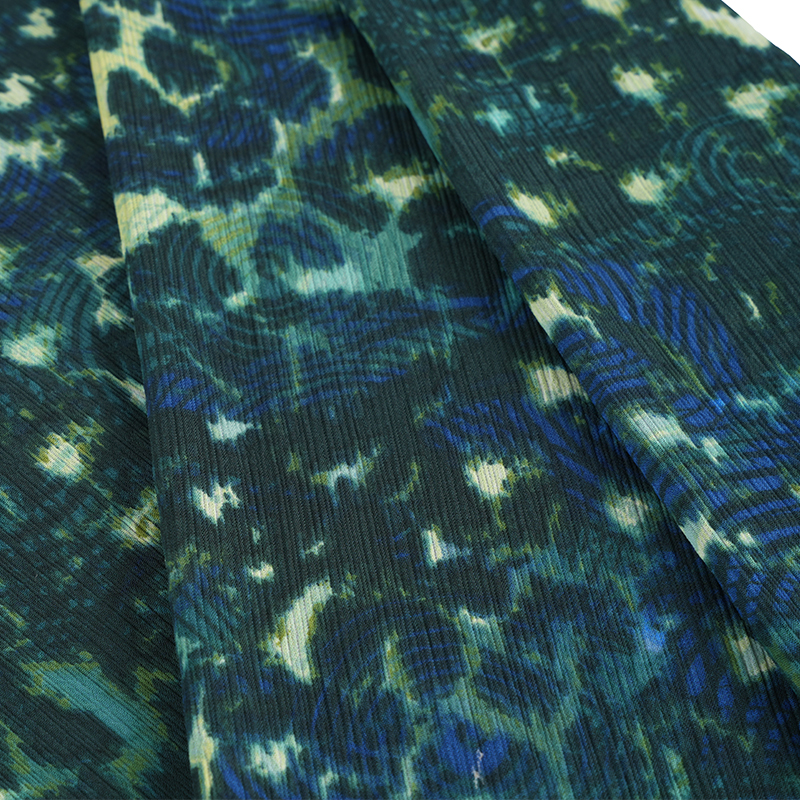
An excellent reference point for a crinkled CEY-based structure is the 180D CEY ice silk crepe de chine, which demonstrates how the fiber base can be finished to achieve a more pronounced rippled texture while retaining the dimensional stability of a filament product.
Sourcing Checklist for CEY Crepe Buyers
Whether you are purchasing for a collection launch or a large bulk order, apply this checklist to your vendor conversation:
- Prepare detailed specifications—including denier, weight, weave, and finish requirements.
- Request shrinkage and colorfastness data sheets before sampling.
- Obtain a sewing test sample, especially if the target garment has a fitted cut.
- Confirm the supplier's dyeing and finishing capacity in-house; outsourcing introduces schedule risk.
- Ask for reference orders with comparable fabric weight and color depth.
Conclusion: Positioning CEY Crepe Material in Your Product Range
CEY crepe material is a dependable, versatile polyester textile whose dry hand and resilient drape make it a workhorse for women's apparel. Its technical requirements—high-twist yarns, controlled dyeing, and careful finishing—demand attention during supplier selection. Buyers who verify the weave consistency, sewing behavior, and shrinkage data before bulk orders substantially reduce the risk of production surprises. With the right sourcing approach, CEY crepe enables designers to build cohesive collections that meet performance expectations without sacrificing aesthetic surface interest.
 Previous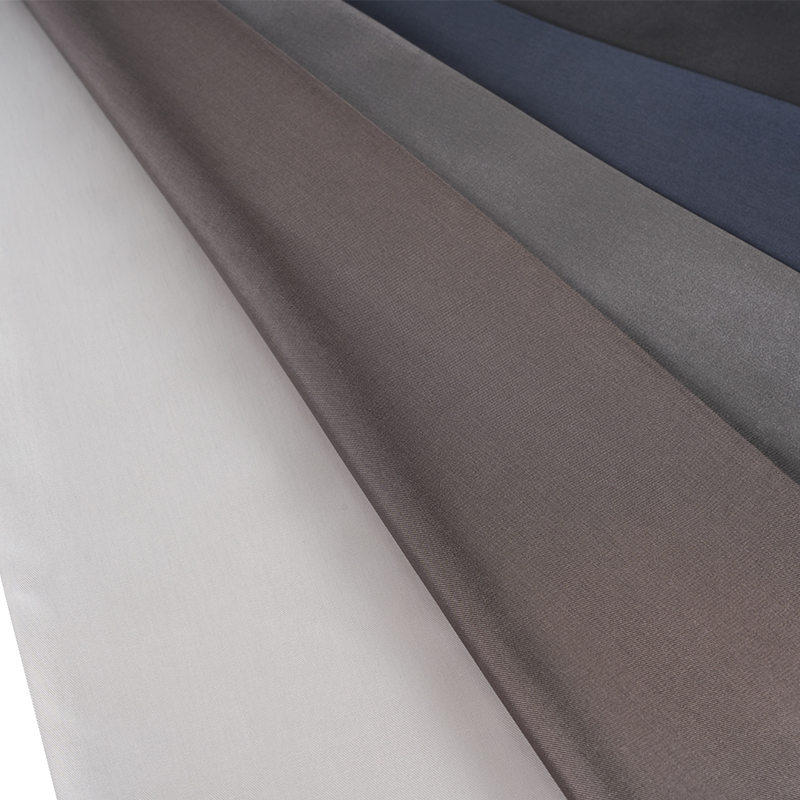

 +86-81163100 / +86-13957571090
 Room B12148, Wanguo Center, No. 1388, Jinkeqiao Avenue, Keqiao, Shaoxing, Zhejiang, China