
 English
 中文简体
中文简体
Approve a linen swatch in February and you can still lose the season to a number that never appears on a sample card: residual shrinkage. A 55% linen / 45% rayon stripe that measures correctly at 140 cm can pull in by 4 cm or more after the first home wash, which is enough to throw markers, panel lengths and grading out of tolerance across an entire lot.
So the working conclusion comes first: choose the linen family before you discuss price. Whether you are buying 100% linen, a linen blend, linen chiffon or a polyester linen-look cloth decides the weight, the shrinkage tolerance and the slub standard you should be negotiating, and those three numbers move the cost far more than the word "linen" printed on the quotation.
What makes linen behave the way it does
Linen comes from the stem of the flax plant. The fibre bundles are freed by retting, then hackled and spun, and the resulting filaments run 25 to 60 cm long, roughly ten times a cotton staple. That length explains most of the fibre's commercial behaviour.
- Low elongation, around 2 to 4% before break, against roughly 20 to 30% for wool. Linen has very little room to stretch, so it creases instead of recovering.
- High moisture regain, close to 12% at standard conditions, compared with about 8% for cotton and 0.4% for polyester. It takes up perspiration and releases it again quickly, which is why linen feels cool in humid weather.
- Higher strength when wet, roughly 20% above dry strength. Water alone does not break linen fibres easily; the damage in a laundered shirt usually comes from mechanical abrasion at collars and cuffs.
- Almost no lint and no pilling. Long fibres do not work loose from the yarn, so the surface stays clean, but abrasion eventually shows as thinning and then as holes.
The consequence is practical rather than academic. Linen is a strong candidate for a shell fabric, a dress or a home textile, and a poor candidate for a lining, where viscose, polyester and acetate are chosen because they slide and recover. Buyers who want the linen look without the creasing pay for a blend, a finish, or a polyester imitation.
The four linen families that reach a quotation
Four different materials are routinely sold under the name linen fabric, and their cost structures barely overlap. Ask which family is being priced before you compare anything else.
| Family | Typical content | Finished weight | Hand | Where it earns its price |
|---|---|---|---|---|
| 100% linen | Flax, wet-spun or dry-spun | 140–280 gsm | Crisp, dry, creases | Shirting, dresses, suiting, home textiles |
| Linen blend | 30–55% linen with viscose, cotton, nylon or lyocell | 130–220 gsm | Softer drape, fewer slubs | Blouses, dresses, soft tailoring |
| Linen chiffon | High-twist linen or linen-look yarns, open set | 60–110 gsm | Sheer, grainy, matte | Overlays, scarves, headscarves, summer tops |
| Linen look (polyester) | 100% polyester or poly/viscose with slub yarn | 100–180 gsm | Springy, dry touch | Volume programmes, uniforms, price-led ranges |
Weight is the fastest sanity check on a quotation. The chart below shows where each family normally lands once the cloth is dyed and finished.
Linen chiffon60–110 gsm
Linen look (polyester)100–180 gsm
Linen blend130–220 gsm
100% linen shirting140–200 gsm
100% linen suiting220–280 gsm
A 60 gsm claim on 100% linen shirting, or a 280 gsm claim on a blend, is a signal that either the yarn content or the finishing route needs to be questioned long before sampling starts.
Linen chiffon: the lightest commercial end of the range
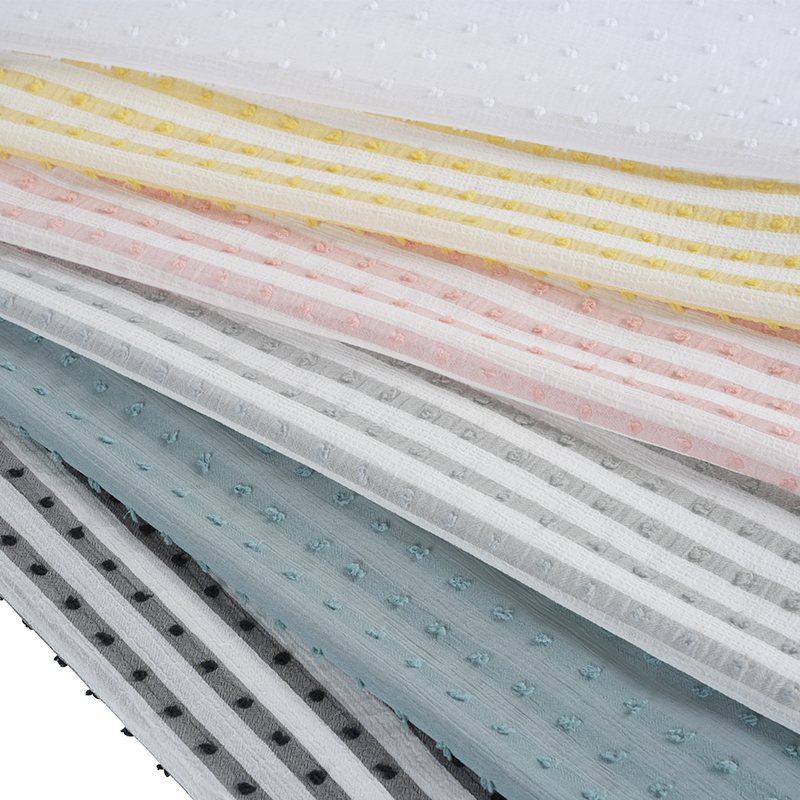
Linen chiffon is where linen's dry hand meets a sheer, open construction. High-twist yarns, often 75D or 100D, are woven at low density and dyed, producing a 60 to 110 gsm cloth with a grainy, matte surface that reads as linen but drapes like chiffon.
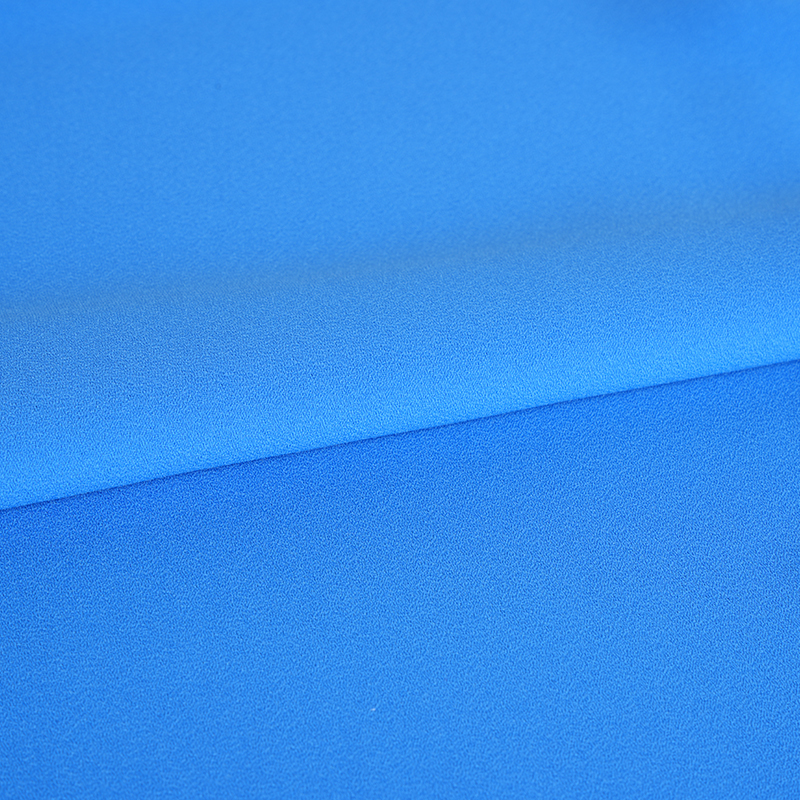 75D Mess Dyed Polyester Chiffon Fabric MF11004-24A lightweight 120 gsm 100% polyester chiffon with an irregular messy-hemp surface, useful for sheer spring/summer designs and inspection planning.View Product →
The trade-offs are structural. Sheer fabrics magnify weaving faults, so a bowed weft, a thick slub in the wrong place or a shade variation between rolls is far more visible than it would be in a 200 gsm suiting. Plan for tighter inspection and slightly higher cutting loss. If chiffon constructions are new to your team, a general guide to chiffon fabric types and care is a sensible place to fix the vocabulary before you write the specification.
Blends: what each partner fibre does to linen
Most commercial linen reaches the market as a blend, because blending fixes linen's two most expensive habits: creasing and inconsistency. Each partner fibre changes a different property.
- Viscose or rayon, usually at 45 to 55%: adds drape and a cooler, softer hand and reduces cost, but raises shrinkage and lengthens drying time.
- Cotton: softens the cloth and reduces surface slub; a 55/45 linen-cotton is easier to finish and cheaper, at the expense of crispness.
- Polyester: improves crease recovery and dimensional stability and lowers the price, while reducing breathability.
- Nylon: adds strength and abrasion resistance in light linen-look substrates.
- Lyocell: smooths the surface and improves drape while keeping a cellulosic hand.
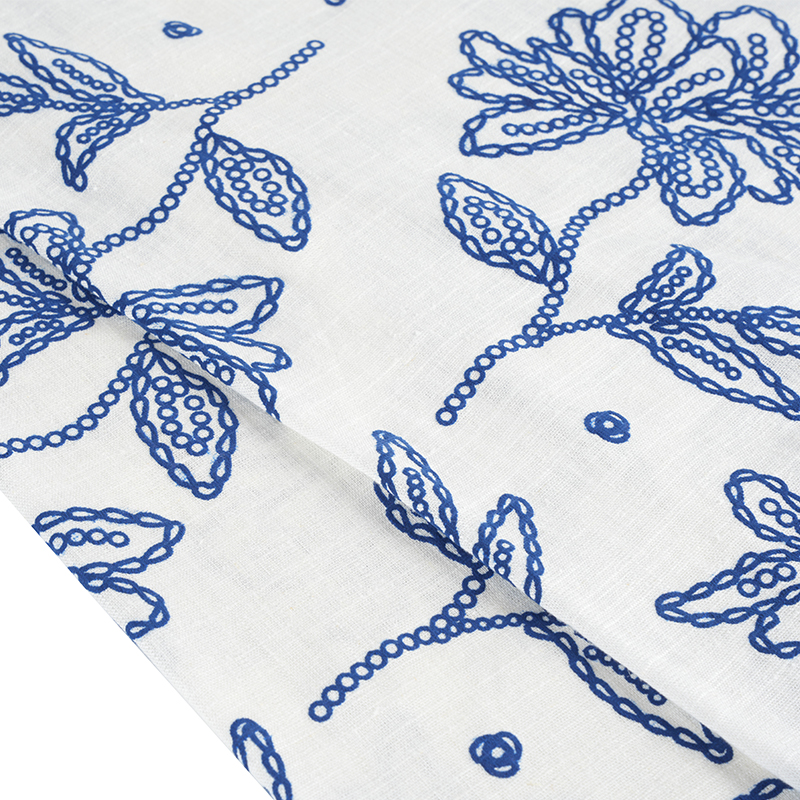
A yarn-dyed linen-viscose stripe is a good example of the blend logic: the linen supplies the surface character, the viscose supplies drape and colour depth, and the finished cloth handles like neither fibre alone.
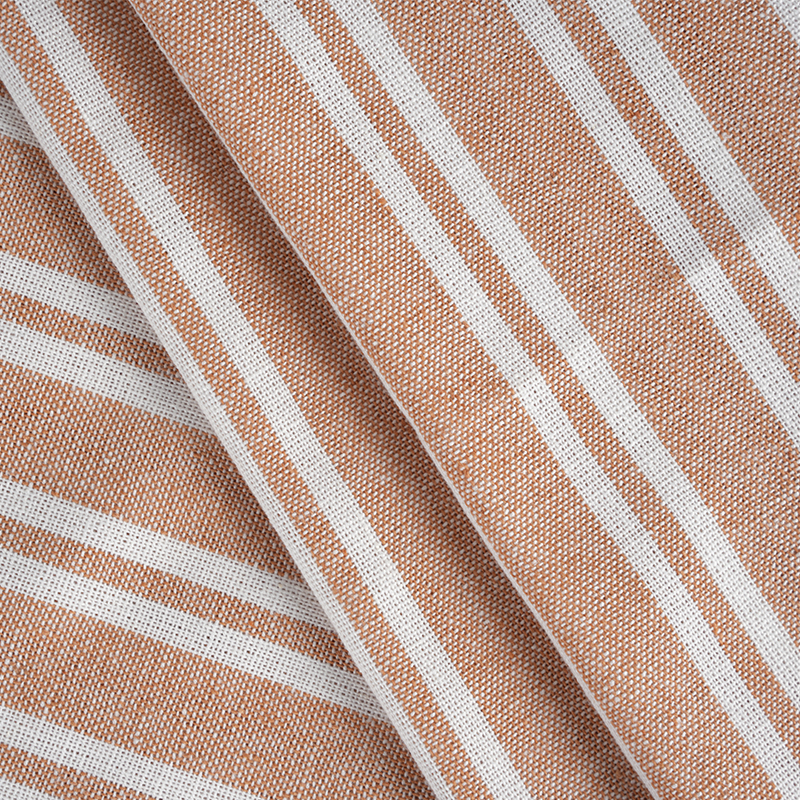 55% Linen 45% Rayon Yarn-Dyed Stripe Fabric PLRF61004A 176 gsm linen-rayon stripe balancing breathability, drape and colour depth; test both fibres for shrinkage and wet rubbing.View Product →
When you test a blend, test both fibres. A cloth can pass every linen-related check and still fail on the viscose side through shrinkage or wet rubbing.
Linen look: when polyester is the better commercial decision
Polyester linen-look fabric exists because volume buyers keep asking for linen's surface at half the cost and none of the ironing. Spun-look and slub yarns imitate the irregular thickness of flax, and the finished cloth holds a crease, resists shrinkage and keeps its shade across large lots far more predictably than a natural linen can.
Where it wins: uniform programmes, workwear, printed ranges where the print carries the design, and price-driven seasonal collections. Where it loses: the hand is springy rather than dry, it holds heat, and it will not develop the softened appearance a real linen shirt acquires after twenty washes.
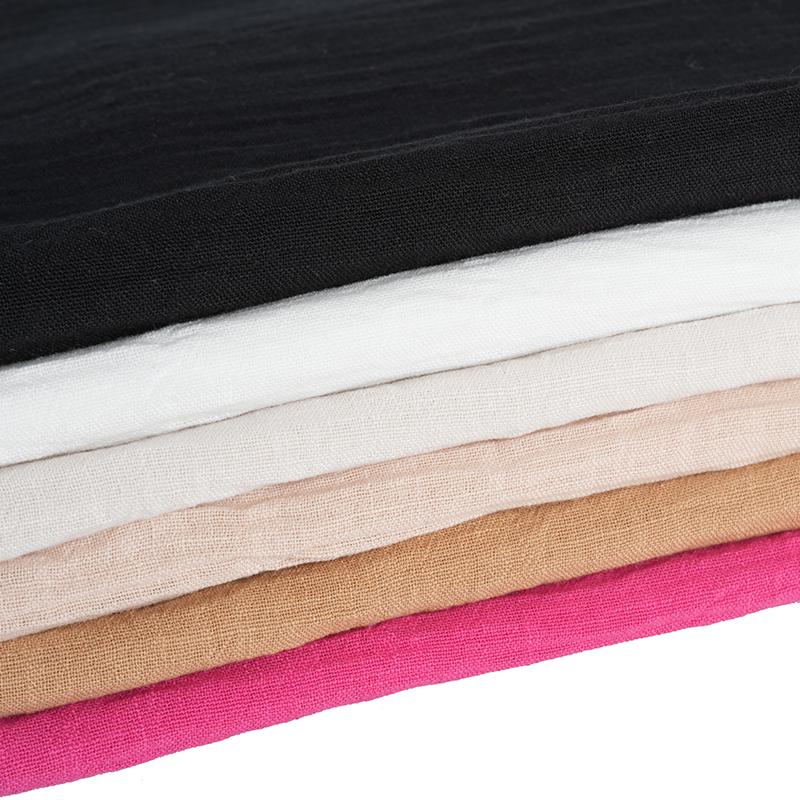 16S Spun Poly Fake Linen Fabric PTF11919A 160 gsm 100% polyester imitation linen with easy-care wrinkle resistance; suitable for uniform, workwear or price-driven programmes with correct fibre labelling.View Product →
One labelling warning. Fibre content must be declared in the EU, the US and most other markets, and a polyester cloth may not be sold as linen. It is described as linen look, faux linen or imitation linen in the specification and on the care label, and the same wording should appear on your customs documentation.
Shrinkage, tolerance and the checks that catch problems early
Write every linen order around a residual shrinkage figure and a named test method. Loom-state linen can move 6 to 9% in the first wash, while sanforised or pre-shrunk cloth should sit near 2 to 4%, and a polyester linen look near 1%.
Loom-state 100% linen6–9%
Pre-shrunk 100% linen2–4%
Linen / viscose blend3–5%
Linen / cotton blend2–4%
Polyester linen look0.5–1.5%
Five checks cover most of the risk in a linen programme.
- Ask for the wash method and the number of cycles, typically three cycles at 40°C with line drying, and require warp and weft shrinkage to be reported separately.
- Specify skew and bowing after wash, not before. Linen moves more in the weft, and a striped or printed fabric shows that movement immediately.
- Test colourfastness to washing, wet rubbing and light on the bulk dye lot rather than on the development sample.
- Approve the slub standard on a metre of bulk, because slub density is a style decision that shifts between yarn lots.
- Run your own wash test before the cutting table. One metre from bulk, washed and measured, costs far less than a rejected shipment.
Care instructions follow from the fibre. Wash linen and linen blends at 30 to 40°C with a mild detergent, skip chlorine bleach, dry in shade or tumble on low heat, and iron damp on the reverse at high temperature. A blend takes the lowest common denominator of its two fibres, so a 55% linen / 45% rayon stripe should be treated as a viscose.
Linen programmes rarely fail because the fibre was poor. They fail because the family, the weight and the shrinkage tolerance were never agreed in that order. Fix the family first, attach a number and a test method to shrinkage, approve the slub on bulk, and run your own wash test before the cutter starts. The price you negotiate afterwards will hold.
If you want to see how linen blends sit alongside linings, chiffon and headscarf fabrics inside one supplier range, the full fabric list is published on our site.


 +86-81163100 / +86-13957571090
 Room B12148, Wanguo Center, No. 1388, Jinkeqiao Avenue, Keqiao, Shaoxing, Zhejiang, China