
 English
 中文简体
中文简体
The Technical and Aesthetic Role of Specialized Vestimentary Linings
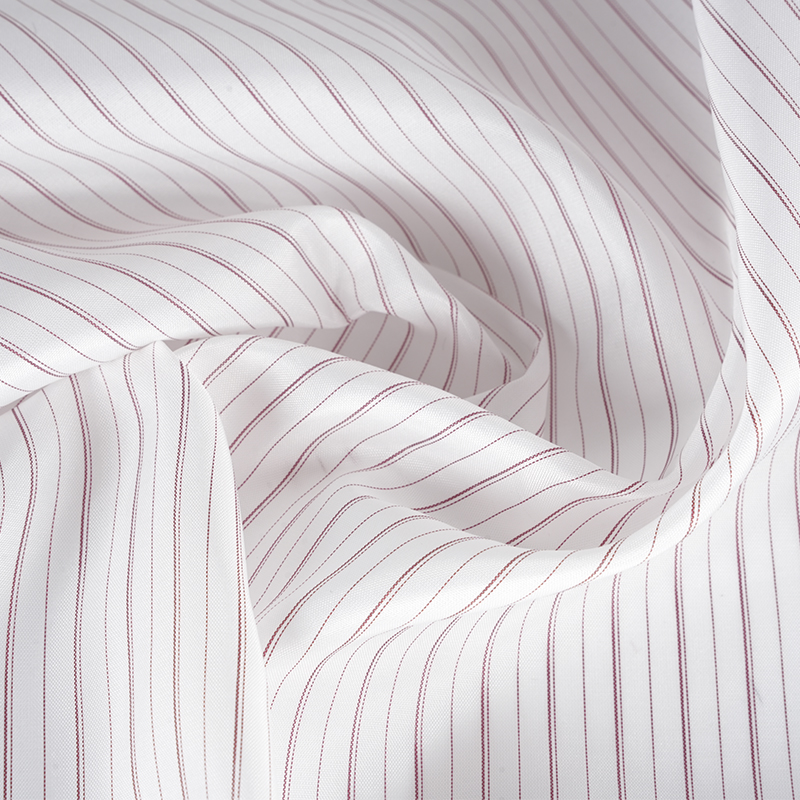
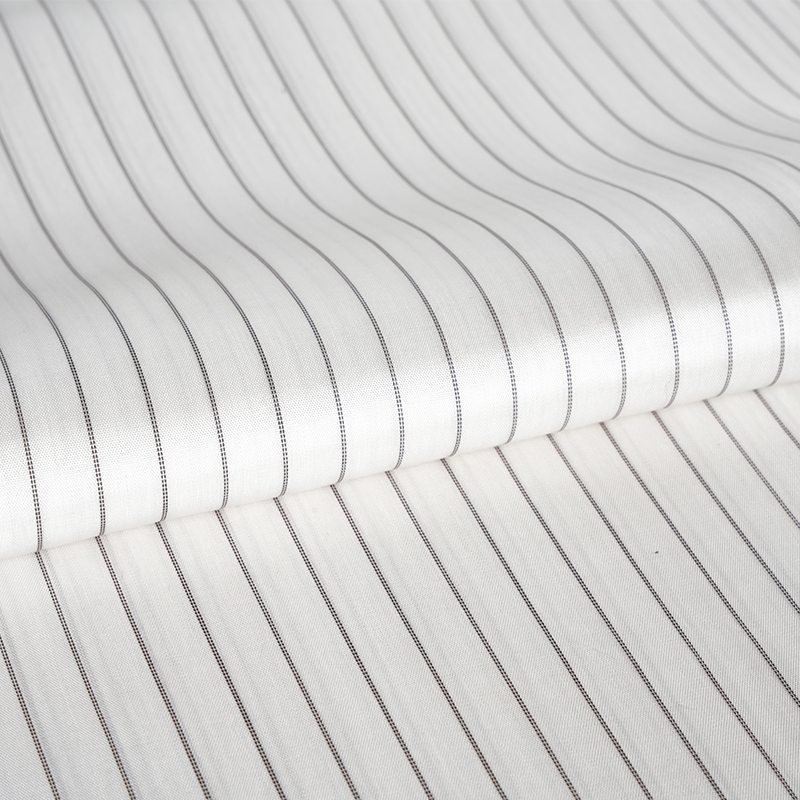
A high-quality dobby striped lining is an engineered inner-garment textile woven on a specialized dobby loom that incorporates small, geometric patterned stripes directly into the structural fabric matrix to optimize friction reduction, moisture management, and interior durability. Far from being a mere decorative afterthought, the interior lining serves as the mechanical interface between the outer shell of a garment and the wearer’s underlying apparel. By integrating subtle geometric relief patterns through alternating warp and weft manipulations, this material achieves a structural slipperiness that prevents tailored jackets, overcoats, and formal trousers from binding, catching, or bunching during human locomotion.
In industrial garment manufacturing and premium bespoke tailoring, the choice of inner lining dictates the overall drape and longevity of the final product. Low-grade linings, such as non-tempered plain-weave polyesters, trap metabolic heat, suffer from premature yarn slippage at high-stress seam junctions, and generate excessive static electricity. Incorporating a dobby striped variant shifts a garment’s performance footprint toward exceptional structural dimensional stability and passive thermal comfort, maintaining the designed silhouette of the outerwear over years of continuous usage.
The functional complexity of these fabrics extends past basic aesthetics into advanced material science. The woven geometry creates microscopic air pockets along the surface of the textile. These pockets minimize the total surface contact area against underlying clothing layers, effectively reducing the coefficient of kinetic friction while facilitating the convective transfer of body vapor. Understanding the weave configurations, polymer matrices, and structural parameters of this material is indispensable for contemporary textile engineers and technical apparel designers.
Structural Mechanics of the Dobby Weaving System
The defining characteristics of a dobby striped fabric stem directly from the mechanical kinematics of the loom used during its production. Dobby looms control individual or grouped heddle frames via electronic or mechanical program selectors, enabling complex variations that cannot be replicated on basic plain-weave cam looms.
Heddle Manipulation and Pattern Selection
Unlike Jacquard weaving machines, which utilize individual cord controls to execute free-form curvilinear designs, a dobby loom manages its warp yarns using a distinct number of shafts, typically ranging from 12 to 24 harnesses. This specific mechanical constraint limits the design profile to small, repeating geometric motifs, including diamonds, piques, chevrons, and crystalline stripes. The repeating pattern is hard-coded into the loom’s sequence, ensuring absolute uniformity across thousands of linear meters of woven output.
To create the characteristic striped effect, the textile engineer programs alternating groups of warp threads to execute distinct weave configurations. For example, a 50mm pattern repeat might feature a 30mm section of high-density satin weave bordered by 10mm sections of fine geometric twill or diamond pique. This localized variation alters the light reflection properties and surface topography of the fabric, yielding a visible and tactile stripe that is structurally integrated into the material rather than superficially printed onto it.
Warp and Weft Density Control
Premium lining fabrics necessitate high thread densities to prevent the fine yarns from migrating when subjected to localized stress, such as at the armhole or center-back seam of a tailored jacket. A typical industrial-grade lining specification requires a warp density of at least 48 to 60 threads per centimeter, utilizing low-denier, high-filament yarns to ensure smooth surface properties.
During the beat-up phase of the weaving cycle, the reed forces the weft yarn into the shedding configuration at a uniform beat-up tension. In dobby striped structures, managing the take-up speed of the fabric beam is crucial. Because different weave structures within the same cloth pull yarn at varying rates of crimp, the loom must be precisely calibrated to balance warp tension variations, preventing puckering along the boundary lines where the geometric stripes interface with the satin background.
Polymer Composition and Yarn Selection Metrics
The raw material base of a lining fabric determines its tactile hand, moisture regain capacity, static generation profile, and resistance to dry-cleaning chemistry. Modern textile manufacturing leverages both natural polymers and advanced synthetic filaments to achieve specific performance goals.
Cuprammonium Rayon, frequently classified as Bemberg, represents the premium benchmark for high-end dobby linings. Regenerated from cotton linter cellulose using a copper-ammonium alkaline solution, this filament features a completely round cross-section and an exceptionally uniform molecular structure. This material achieves a moisture regain value of approximately 11% to 12%, allowing it to absorb ambient sweat vapor and cool the wearer via evaporative dissipation, while exhibiting natural anti-static properties that eliminate fabric cling.
For high-volume commercial garment manufacturing, Viscose Rayon and Acetate filaments provide cost-effective alternatives. Viscose, also derived from wood pulp cellulose, delivers deep color saturation and a supple hand, although it suffers from reduced tensile strength when wet. Acetate, a chemically modified cellulose ester, provides a crisp, silk-like rustle and excellent drape, but displays lower abrasion resistance metrics over extended wear cycles, requiring careful blending configurations to ensure long-term durability.
In technical sportswear or highly durable utility outerwear, multi-filament polyester or nylon-6,6 matrices are utilized. Synthetic yarns offer excellent tensile break strength and low manufacturing costs, but their low moisture regain value (typically under 0.4% for polyester) requires modifying the filament surfaces with hydrophilic finishes or utilizing hollow-core yarn geometries to facilitate mechanical moisture wicking along the dobby stripe channels.
Tribological Performance and Boundary Layer Friction
The primary mechanical function of an inner lining is to reduce boundary friction between dissimilar fabric layers. When a wearer moves their arms, the sleeve lining of a coat slides continuously over the shirting fabric worn beneath it. This interaction can be analyzed using classic tribological principles, focusing on the coefficient of kinetic friction ($\mu_k$).
Standard flat silk or simple satin weaves provide a low friction coefficient when dry, but can experience stick-slip phenomena if moisture accumulates between the layers, causing the fabrics to cling. The multi-level surface topography of a dobby striped fabric solves this issue. By lifting parts of the weave structure slightly above the baseline plane, the dobby pattern acts as a mechanical spacer, decreasing the true contact area ($A_r$) between the lining and the underlying garment.
This reduction in contact area lowers the shear forces required to slide the fabrics past one another. Standardized friction tests using sliding friction testers indicate that a high-grade dobby lining can maintain a stable kinetic friction coefficient of under 0.25 even at elevated relative humidity levels. This prevents the outer jacket from pulling out of alignment during physical movement, protecting the master pattern lines established by the cutter.
Performance Matrix: Lining Material Configurations Compared
Selecting the optimal lining for a premium outerwear collection requires balancing physical comfort metrics against industrial processing capabilities and material costs. The table below details the performance characteristics across standard fiber configurations utilized in dobby striped productions.
| Fiber Composition Type | Moisture Regain Rate (%) | Static Charge Generation Metric | Dry-Abrasion Cycle Limit (Martindale) | Thermal Regulation Performance |
|---|---|---|---|---|
| 100% Cupro (Bemberg) Filament | 11.5% - 12.5% | Minimal (< 500V) | High (> 35,000 cycles) | Excellent (Endothermic cooling) |
| Viscose / Acetate Blend | 7.0% - 9.0% | Low to Moderate | Moderate (approx. 20,000 cycles) | Good (Standard breathability) |
| Micro-Filament Polyester | 0.2% - 0.5% | Severe (> 4000V without finish) | Maximum (> 60,000 cycles) | Poor (Traps sensible sweat) |
| Silk / Cotton Dobby Hybrid | 9.5% - 11.0% | Minimal | Low (Requires delicate cleaning) | Very Good (Luxury thermal profile) |
The performance data indicates that while micro-filament polyesters offer exceptional abrasion resistance for heavy commercial uniform applications, regenerated cellulosic options like Cupro provide superior performance for luxury tailoring. Cupro's high moisture regain and low static charge generation prevent common lining issues such as static shock and skin irritation, enhancing comfort in close-fitting garments.
Bespoke Tailoring Integration and Engineering Protocols
Integrating a dobby striped lining into a tailored jacket is a precise mechanical process. Because these linings are slippery and flexible, tailors use specific assembly techniques to ensure the lining accommodates the stretch of the outer shell fabric without distortion.
Phase 1: Thermal Stabilization and Decatizing
Before cutting out pattern pieces, the lining must be stabilized against future thermal shrinkage caused by commercial steam pressing. The fabric undergoes a relaxation press or decatizing process, where low-pressure steam passes through the rolled textile. This prevents the lining from shrinking inside the finished coat, which could otherwise pull the outer shell inward and pucker the external seam lines.
Phase 2: Grain Alignment and Pattern Layout
The prominent stripes of the dobby design must be aligned perfectly parallel to the vertical grain line of the garment panels. For center-back assemblies and internal breast pockets, the master cutter must match the geometric pattern repeats across the left and right panels. Any angular misalignment of the stripe pattern will be visible when the coat is unbuttoned, detracting from the garment's interior symmetry.
Phase 3: Provisioning the Ease Pleat System
Lining fabrics are inherently non-elastic. To allow the wearer to extend their arms forward without tearing the delicate lining material, the tailor must build in an ease pleat system.
- Cut the back lining panel approximately 20mm to 30mm wider than the matching outer shell wool fabric.
- Fold the excess material along the vertical centerline to establish a functional box pleat or inverted drape pleat.
- Secure the top and bottom of the pleat with flexible silk basting threads, allowing the internal lining to open and expand when the wearer exercises muscle expansion across their shoulder blades.
Phase 4: Felling the Hems and Armholes
The final attachment of the lining along the coat hem and around the armhole perimeter is executed using a hand-sewn felling stitch or a specialized blind-hem industrial machine. The stitch length must be held to a fine gauge, typically 4 to 5 stitches per centimeter, utilizing high-lubricity silk or lubricated polyester core-spun threads. The stitches should remain slightly loose, allowing the lining to float over the interior canvas construction without pulling tightly against the outer edge.
Quality Control metrics and Textile Failure Analysis
Apparel manufacturing laboratories test dobby lining configurations using strict testing protocols. Because linings are hidden inside the garment, hidden structural defects can quickly lead to seam separation or surface fuzzing, compromising quality before the outerwear reaches its expected wear life.
The most critical mechanical vulnerability in woven lining textiles is seam slippage, evaluated via standard ASTM D434 or ISO 13936 parameters. Seam slippage occurs when the warp or weft yarns pull out of alignment under tension, creating gaps along the stitch line. Because dobby stripe weaves incorporate float-heavy configurations like satin variations alongside plain structures, the boundaries between patterns are susceptible to yarn shifting. Testing protocols apply a constant mechanical load of 60 Newtons to a mock seam, verifying that the total yarn displacement remains securely below a strict 2.0mm threshold.
Another testing metric is resistance to pilling and surface fuzzing, measured using Martindale Abrasion testers. As the inner lining rubs against rough formal belts or pocket contents, individual structural filaments can fracture, creating small fiber tangles that increase surface friction. Incorporating a high-twist yarn structure during spinning minimizes filament breakage, allowing the fabric to pass 20,000 abrasion cycles without surface pilling.
Finally, colorfastness to both dry-cleaning solvents (perchloroethylene) and acidic perspiration is verified using standard gray scale evaluations. Because lining materials are subjected to sweat under the armholes, the reactive dyes used must bind tightly to the polymer chain. This cross-linking prevents color bleeding onto fine shirting fabrics, ensuring the garment maintains a pristine appearance inside and out over years of professional maintenance cycles.
Sustainability and Chemical Management Frameworks
The environmental impact of manufacturing inner linings has driven significant innovation in textile processing. Traditional manufacturing of regenerated cellulose or synthetics requires substantial inputs of fresh water, energy, and solvent chemicals, prompting the adoption of closed-loop processing and verified eco-certifications.
In premium cupro and viscose dobby production, factories use closed-loop chemical reclamation systems. These systems capture and reuse up to 99% of the chemical solvents and ammonia processing fluids within a continuous processing cycle. This design minimizes the release of harmful alkaline wastewater into aquatic ecosystems while lowering raw material usage across the production lifecycle.
For synthetic dobby fabrics, manufacturers are shifting toward post-consumer recycled polyethylene terephthalate (rPET) derived from recycled maritime plastics and water bottles. Converting rPET flakes back into multi-filament lining yarn reduces carbon emissions by up to 40% compared to virgin petroleum-based production processing, while providing identical tensile strength and sliding performance metrics.
To verify compliance with global safety standards, modern dobby linings are certified under frameworks like OEKO-TEX Standard 100 or the Global Recycled Standard (GRS). These independent testing protocols ensure that the fabric is free from harmful levels of heavy metals, formaldehyde, and allergenic disperse dyes, confirming that the high-performance lining material is safe for long-term contact with human skin.
 Previous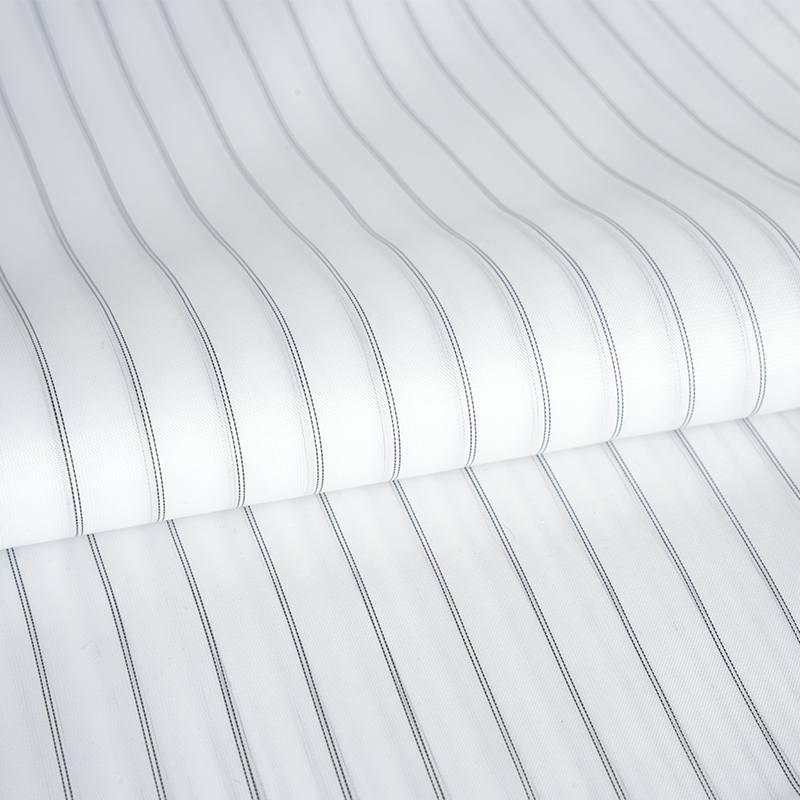

 +86-81163100 / +86-13957571090
 Room B12148, Wanguo Center, No. 1388, Jinkeqiao Avenue, Keqiao, Shaoxing, Zhejiang, China