

 English
 中文简体
中文简体
The Verdict: Crepe Chiffon Offers the Best Drape-to-Weight Ratio of Any Sheer Fabric
Crepe chiffon fabric combines the lightweight transparency of standard chiffon with the distinctive crinkled texture and superior drape of crepe yarns. With a typical weight range of 25-40 GSM (grams per square meter) and a drape coefficient below 45% (excellent drape), crepe chiffon outperforms standard chiffon in wrinkle resistance by 60-70%. The direct conclusion: for sheer apparel requiring flow and structure—wedding veils, evening gown overlays, blouses, and scarves—crepe chiffon is the superior choice over plain-weave chiffon or georgette.
What Makes Crepe Chiffon Different from Standard Chiffon
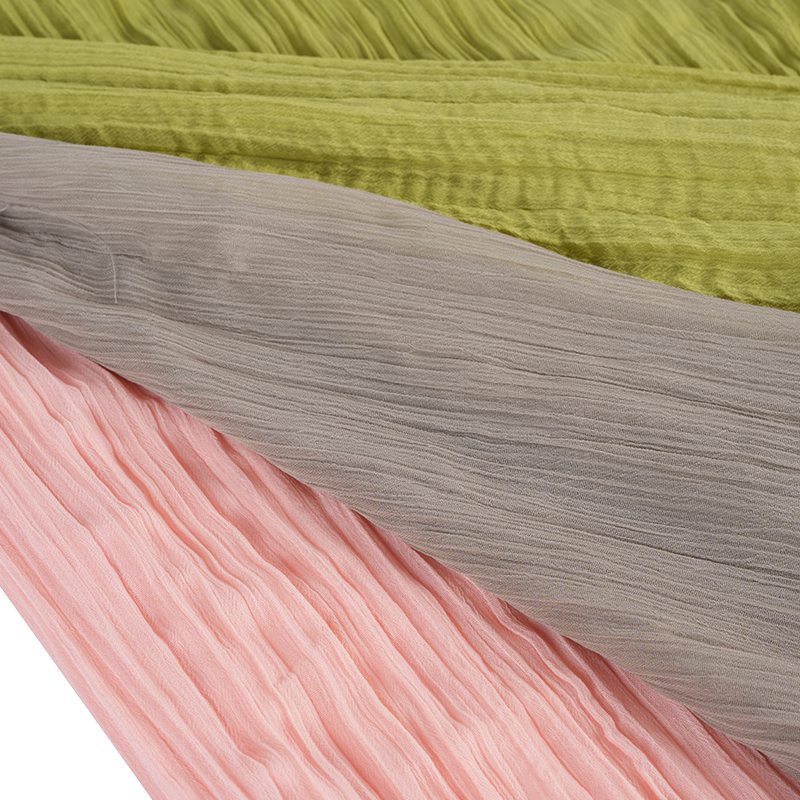
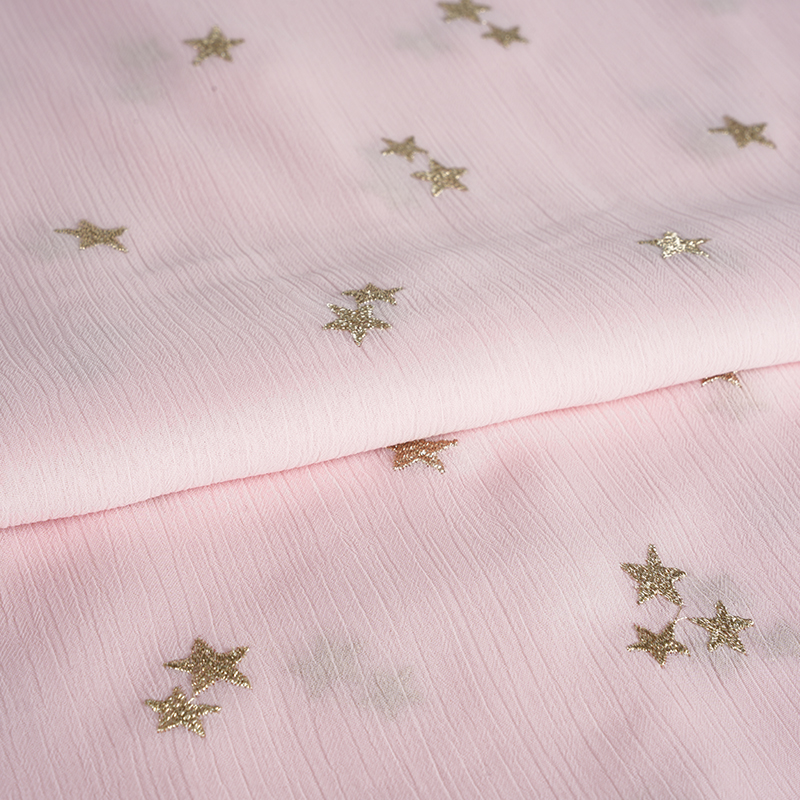
Crepe chiffon fabric is distinguished from standard chiffon by the twist direction and tension applied to the yarns before weaving. Crepe yarns are highly twisted—typically 2,200 to 3,000 twists per meter (TPM)—compared to 800-1,200 TPM for standard chiffon yarns. The high twist causes the yarns to kink and buckle during weaving, creating the signature pebbled or crinkled surface texture. After weaving, crepe chiffon undergoes a relaxation or heat-setting process that locks in the crinkle while maintaining the open, translucent structure. Standard chiffon uses low-twist yarns, resulting in a smooth surface but lower wrinkle recovery.
The twist direction also matters: crepe chiffon often uses S-twist and Z-twist yarns alternately (a "crepe weave"), which increases surface friction and prevents yarn slippage. This construction gives crepe chiffon better seam stability than standard chiffon—seams are less likely to pull out or run. In seam slippage tests (ASTM D4034), crepe chiffon requires 30-40% more force to cause seam slippage than standard plain-weave chiffon of equivalent GSM.
</>| Property | Crepe Chiffon | Standard Chiffon | Georgette |
|---|---|---|---|
| Typical GSM (weight) | 25-40 | 20-35 | 35-55 |
| Yarn twist (TPM) | 2,200-3,000 | 800-1,200 | 1,800-2,500 |
| Surface texture | Crinkled, matte | Smooth, slight sheen | Pebbled, matte |
| Drape coefficient (%) | 40-48 (excellent) | 55-65 (good) | 45-55 (very good) |
| Wrinkle recovery angle | 280-310° | 220-250° | 270-300° |
| Opacity (scale 1-10) | 2-3 | 2-3 | 3-4 |
Fiber Composition: Silk, Polyester, and Blends
Crepe chiffon fabric is available in three primary fiber compositions, each with distinct performance characteristics. Silk crepe chiffon (100% mulberry silk) is the premium option, offering the best drape, natural temperature regulation, and moisture absorption (30% of its weight). However, silk crepe chiffon costs $30-80 per yard—10-20x more than polyester versions. It also requires dry cleaning or gentle hand washing; machine washing causes irreversible loss of sheen and can reduce tensile strength by 40-50%.
Polyester crepe chiffon dominates the market at $3-8 per yard. 100% polyester crepe chiffon has higher tensile strength (3-5 kg per cm width) than silk (2-3 kg per cm), better wrinkle recovery (300° vs 280°), and is machine washable. However, polyester traps body heat and has lower moisture absorption (0.4% vs 30% for silk), making it less comfortable in hot, humid conditions. Blended fabrics (silk/polyester, typically 70/30 or 50/50) aim to balance cost and comfort but require careful processing—uneven twist tension between silk and polyester yarns creates visible streaking. For apparel against skin in summer, silk or high-quality polyester microfiber versions are recommended over standard polyester.
GSM Weight Selection by Garment Type
Crepe chiffon fabric weight (GSM) directly affects garment opacity, drape, and durability. Lighter weights (25-28 GSM) are suitable for scarves, overlays, and veils where maximum transparency is desired. These weights have the best fluid drape but tear easily—tensile strength under 2 kg per cm. Medium weights (28-33 GSM) are the most versatile for blouses, dresses, and skirts, balancing opacity (requires lining for full coverage) with durability. Heavy weights (33-40 GSM) approach georgette territory, offering better opacity (often no lining needed) and higher tear resistance, but with slightly stiffer drape.
For evening gown overlays, specify 25-28 GSM to maintain fluid movement over the underlayer. Blouses intended for professional wear (requires opacity) should use 33-40 GSM. A 5 GSM difference—from 30 to 35 GSM—increases fabric weight by 17% but reduces transparency by 40-50%. Test opacity by placing the fabric against a printed page; if text is clearly readable through a single layer, the GSM is too low for unlined garments. For lined garments, any GSM from 25-40 is acceptable.
Drape Coefficient and Fabric Hand
Drape coefficient measures how a fabric folds and hangs; lower numbers indicate better drape. Crepe chiffon fabric typically achieves drape coefficients of 40-48% (excellent), compared to 55-65% for standard chiffon. The improved drape comes from the high-twist yarns, which create microscopic bends that allow the fabric to fold more easily. For comparison: a drape coefficient of 35-45% is considered "fluid" (silk charmeuse level); 45-55% is "supple" (typical crepe de chine); above 60% is "stiff" (taffeta or organza).
Fabric hand (tactile sensation) of crepe chiffon is dry and slightly crisp, not slippery. The crinkled surface creates air pockets that reduce skin contact by 30-40% compared to smooth fabrics, making crepe chiffon feel cooler against the skin in warm weather. This dry hand also makes crepe chiffon easier to cut and sew than slippery charmeuse or satin. However, the dry hand means crepe chiffon does not "flow" as dramatically as fluid silks; for waterfall ruffles or cascading drapes, a lower-twist fabric may be preferable.
Shrinkage and Pre-Washing Requirements
Crepe chiffon fabric exhibits significant shrinkage on first washing due to relaxation of the high-twist yarns. Polyester crepe chiffon shrinks 3-5% in length and 2-3% in width on first wash; silk crepe chiffon shrinks 6-8% in length and 4-5% in width. Failure to pre-wash leads to garments that no longer fit after cleaning. For garment production, always pre-wash crepe chiffon using the method recommended for the final garment (machine wash cold delicate for polyester, hand wash cool for silk). After pre-washing, allow the fabric to relax flat for 24 hours before cutting.
The shrinkage mechanism is irreversible. Ironing or heat-setting after shrinkage does not restore the original dimensions—the fabric has permanently changed. For projects requiring exact dimensions (e.g., tailored blouses), order 10-15% extra yardage to compensate for shrinkage. For polyester crepe chiffon, pre-wash a 1-meter sample to measure actual shrinkage; for silk, assume 7% length shrinkage and cut accordingly. Never skip pre-washing on the assumption that "dry cleaning won't shrink it"—dry cleaning solvents still relax twisted yarns, causing shrinkage comparable to water washing.
Cutting and Sewing Recommendations
Crepe chiffon fabric is challenging to cut and sew due to its lightweight and tendency to shift. Use a rotary cutter with a sharp blade (change blades every 2-3 yards) rather than scissors, which drag the fabric and distort the grain. Cut on a single layer only—stacking layers causes the bottom layer to shift by 5-10mm, resulting in mismatched pattern pieces. Use pattern weights (not pins) to hold fabric in place during cutting; pins create permanent holes in crepe chiffon due to the open weave.
For sewing: use a microtex needle (size 60/8 or 70/10) with a sharp point that separates yarns rather than cutting them. Standard universal needles (size 70/10) create skipped stitches on crepe chiffon at 3-5 times the rate of microtex needles. Stitch length: 1.5-2.0mm for seams; longer stitches (2.5mm) allow the fabric to pull apart under stress. Tension: lower upper thread tension to 2-3 (on a scale of 0-9) to prevent the thread from bunching the lightweight fabric. French seams (enclosed seams) are recommended over serged edges—serging adds bulk and stiffness that defeats the drape of crepe chiffon. Test on scraps before sewing the actual garment; sewing parameters vary significantly between polyester and silk versions.
Hemming Techniques for Sheer Edges
Hemming is the most challenging finishing operation for crepe chiffon fabric. Rolled hems (2-3mm final width) are the industry standard, requiring a specialized rolled hem foot on the sewing machine. A properly executed rolled hem lies flat, does not ripple, and maintains the fabric's transparency. Widths above 5mm appear bulky and cause the hem to flare outward. For home sewers without a rolled hem foot, a narrow folded hem (first fold 3mm, second fold 3mm) is acceptable but requires careful pressing (low heat: 110°C for polyester, 150°C for silk) and stitching with a fine needle.
On curved hems (circle skirts, ruffles), rolled hems are difficult to sew without puckering. For curved hems, interface the hemline with 3mm clear elastic or fusible hem tape (nylon mesh, not paper-backed). The tape stabilizes the curved edge, allowing a straight stitch without stretching or gathering. For silk crepe chiffon, avoid fusible interfacing—the heat and adhesive can cause permanent discoloration or stiffening. Use stitch-in hem tape (polyester organdy strip) that is sewn into the hem instead.
Seam Finishes and Strength Testing
Seam strength in crepe chiffon fabric is limited by the fabric itself, not the thread. Tensile testing shows that seams in polyester crepe chiffon fail at 3-4 kg per cm width, with 80-90% of failures occurring as fabric tear (not seam slippage or thread break). This means that stronger stitching does not improve seam strength—the fabric will tear adjacent to the seam under sufficient stress. Therefore, reinforcement techniques (stay-stitching at stress points, using interfacing at shoulders and armholes) are more effective than increasing stitch density.
For high-stress seams (crotch seams in pants, underarm seams in fitted bodices), use a three-step zigzag or stretch stitch (2.5mm width, 1.5mm length). Straight stitches on bias-cut crepe chiffon fail at 40-50% lower load than straight stitches on straight grain. For bias seams (common in cowl necks, drape details), interface the seam allowance with 6mm silk organza or nylon tricot before stitching; this increases seam strength by 100-150% without visible stiffening.
Colorfastness and Dyeing Properties
Polyester crepe chiffon fabric has excellent colorfastness to light (rating 4-5 on the blue wool scale) and to washing (rating 4-5). Polyester fibers are solution-dyed or high-temperature disperse-dyed, resulting in color retention through 50+ washes with less than 10% fade. Silk crepe chiffon has moderate lightfastness (rating 3-4) and poor wetfastness—silk bleeds dye when wet, especially in red, navy, and black shades. For silk crepe chiffon garments, dry cleaning is recommended to prevent dye transfer and color loss.
For custom dyeing: polyester crepe chiffon requires high-temperature (100-130°C) disperse dyeing in a pressure vessel—not possible for home dyeing. Silk crepe chiffon accepts acid dyes easily at 80-90°C, producing vibrant colors with good leveling. However, the high-twist yarns create dye uptake variations: S-twist and Z-twist yarns dye at slightly different rates, potentially creating a subtle two-tone effect (called "crepe effect") that may be desirable or not depending on the application. Test-dye a sample before dyeing production yardage.
Ironing and Steam Finishing
Crepe chiffon fabric requires careful ironing to preserve the crinkled texture. Do not press crepe chiffon flat—this destroys the surface character and produces a shiny, flattened appearance that is difficult to restore. Instead, use steam from a distance (iron held 10-15cm above fabric) to relax wrinkles while maintaining the crinkle. For polyester crepe chiffon, use the lowest steam setting; for silk, use a dry iron on the silk setting (150°C) with a press cloth, applying heat without pressure.
If the fabric becomes wrinkled from storage, mist lightly with water and hang overnight—the weight of the water will pull out wrinkles without heat. Never use a hot iron directly on dry crepe chiffon; polyester melts at 250°C (resulting in hard, shiny spots), and silk burns at 180°C (yellowing and weakening). For garment assembly, press seams open with a cool iron (130°C for polyester, 150°C for silk) and minimal pressure, using a press cloth. Allow seams to cool completely before moving the garment to prevent setting of unintended creases.
Common Defects and Quality Inspection
When purchasing crepe chiffon fabric, inspect for these common defects. Uneven twist (visible as alternating shiny and matte stripes) occurs when twist tension varies across the fabric width. This defect is most visible when the fabric is held up to light. Reject fabric with visible stripe intervals under 50mm—the defect will be noticeable in finished garments. Snags and pulls are common due to the open weave; a single pulled yarn can run for 100mm or more. Inspect fabric on a light table; reject any fabric with more than one snag per 5 square meters.
Selvage distortion (wavy or puckered edges) indicates improper loom tension and will cause seam matching problems. Lay the fabric flat on a cutting table; if the selvage curves by more than 25mm over 1 meter, reject the fabric. For polyester crepe chiffon, test a 30cm x 30cm sample for seam slippage (ASTM D4034) if the garment will have high-stress seams. For silk crepe chiffon, test a sample for water spotting—some silks develop permanent ring marks from water droplets. Dark colors hide water spots more effectively than pastels or whites.
Cost Factors and Budgeting for Production
For apparel brands sourcing crepe chiffon fabric, cost varies by 10-20x depending on fiber and quality tier. Standard polyester crepe chiffon (33 GSM, 112cm width) costs $3-5 per yard FOB China in quantities of 5,000+ yards. Premium polyester (microfiber, improved hand feel) costs $6-10 per yard. Silk crepe chiffon (30 GSM, momme weight 8-10) costs $25-40 per yard for commercial quantities; retail prices exceed $60 per yard. Minimum order quantities for custom-dyed polyester crepe chiffon are typically 1,000-2,000 yards per color; for silk, 500-1,000 yards.
Budget for shrinkage and cutting waste: allow 15-20% waste for polyester crepe chiffon (including pre-wash shrinkage), 20-25% for silk crepe chiffon. Cutting waste is higher than for stable woven fabrics because lightweight fabrics shift during cutting. In production, nested marker layouts for crepe chiffon typically achieve 65-75% fabric utilization, compared to 80-85% for cotton broadcloth. For a 1,000-garment production run, order 1,200-1,300 yards of polyester crepe chiffon or 1,250-1,350 yards of silk to account for waste and allow for quality rejects.
 Previous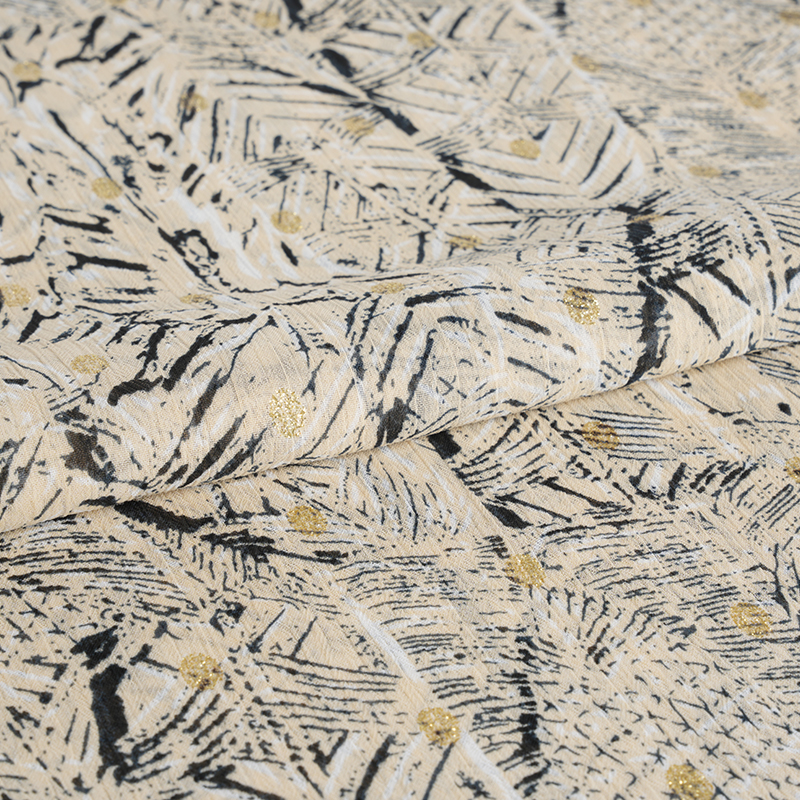

 +86-81163100 / +86-13957571090
 Room B12148, Wanguo Center, No. 1388, Jinkeqiao Avenue, Keqiao, Shaoxing, Zhejiang, China